Description
Material for coupled thermal and stress problems, ex thermoelasticity.
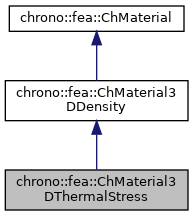
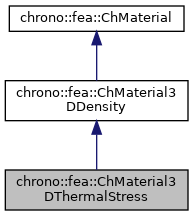
This is implemented here as a composition of two distinct materials, one for the 3D heat problem, which is independent on stress state and which we recycle from the usual ChMaterial3DThermal, and a one for the 3D stress problem, which could be one of the many ChMaterial3DStress classes, ex. StVenant or Mooney-Rivlin or Ogden etc.
#include <ChMaterial3DThermalStress.h>
Public Member Functions | |
| void | SetThermalExpansionCoefficient (double mte) |
| Set thermal expansion coefficient [1/K]. Ex. aluminium (23*10e-6)/K, steel (11*10e-6)/K. | |
| double | GetThermalExpansionCoefficient () const |
| Get thermal expansion coefficient [1/K]. | |
| void | SetRestTemperature (double mt) |
| Set rest temperature [K]. No thermal expanson at point, if point temperature is this. | |
| double | GetRestTemperature () const |
| Get rest temperature [K]. No thermal expanson at point, if point temperature is this. | |
| virtual void | SetDensity (double md) override |
| Set density of material. Both for stress problem and for thermal problem. | |
| virtual void | ComputeUpdateEndStep (ChFieldData *data_per_point, ChElementData *data_per_element, const double time) |
| Update your own auxiliary data, if any, at the end of time step (ex for plasticity). More... | |
| virtual bool | IsSpatialVelocityGradientNeeded () const |
| Some material need info on the spatial velocity gradient l=\nabla_x v , where the time derivative of the deformation gradient F is dF/dt = l*F. More... | |
| virtual std::unique_ptr< ChFieldData > | CreateMaterialPointData () const override |
| Implement this because the material might need custom data per material point. More... | |
 Public Member Functions inherited from chrono::fea::ChMaterial3DDensity Public Member Functions inherited from chrono::fea::ChMaterial3DDensity | |
| ChMaterial3DDensity (double density=1000) | |
| virtual double | GetDensity () const |
| Get the density of the material, in kg/m^2. | |
Public Attributes | |
| std::shared_ptr< ChMaterial3DStress > | material_stress |
| Material for stress field computation. | |
| std::shared_ptr< ChMaterial3DThermal > | material_thermal |
| Material for thermal field computation. | |
Additional Inherited Members | |
| Protected Attributes inherited from chrono::fea::ChMaterial3DDensity | |
| double | m_density |
Member Function Documentation
◆ ComputeUpdateEndStep()
|
inlinevirtual |
Update your own auxiliary data, if any, at the end of time step (ex for plasticity).
This is called at the end of every time step (or nl static step)
- Parameters
-
data_per_point pointer to auxiliary data (ex states), if any, per quadrature point data_per_element pointer to auxiliary data (ex states), if any, per element
◆ CreateMaterialPointData()
|
inlineoverridevirtual |
Implement this because the material might need custom data per material point.
Here the user can have plugged a material_stress of variuous type, so fall back to its custom data creation
Reimplemented from chrono::fea::ChMaterial.
◆ IsSpatialVelocityGradientNeeded()
|
inlinevirtual |
Some material need info on the spatial velocity gradient l=\nabla_x v , where the time derivative of the deformation gradient F is dF/dt = l*F.
Some others, do not need this info. For optimization reason, then, the ChFEModelXXYY queries this, and knows if the "l" parameter could be left to null when calling ComputeStress(...)
The documentation for this class was generated from the following file:
- /builds/uwsbel/chrono/src/chrono/fea/multiphysics/ChMaterial3DThermalStress.h