Description
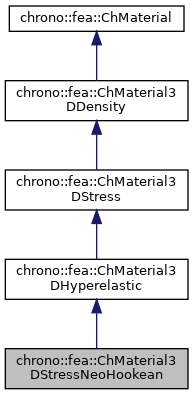
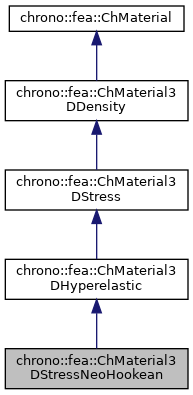
Class for properties of the 3D elasticity from Neo-Hookean model.
It is a simple type of hyperelastic material that, for small strains, converges to linear elasticity. Yet can be used for large rotations etc. Better than the ChMaterial3DStressStVenant because it can withstand larger compression. It can be used for metals and rubber (up to moderate deformations)
#include <ChMaterial3DStressNeoHookean.h>
Public Member Functions | |
| ChMaterial3DStressNeoHookean (double young=10000000, double poisson=0.4, double density=1000) | |
| void | SetYoungModulus (double E) |
| Set the Young elastic modulus, in Pa (N/m^2), as the ratio of the uniaxial stress over the uniaxial strain, for hookean materials. | |
| double | GetYoungModulus () const |
| Get the Young elastic modulus, in Pa (N/m^2). | |
| void | SetPoissonRatio (double v) |
| Set the Poisson ratio, as v=-transverse_strain/axial_strain, so takes into account the 'squeezing' effect of materials that are pulled. More... | |
| double | GetPoissonRatio () const |
| Get the Poisson ratio, as v=-transverse_strain/axial_strain. | |
| void | SetShearModulus (double G) |
| Set the shear modulus G, in Pa (N/m^2). More... | |
| double | GetShearModulus () const |
| Get the shear modulus G, in Pa (N/m^2) | |
| double | GetLameFirstParam () const |
| Get Lamé first parameter (the second is shear modulus, so GetShearModulus() ) | |
| double | GetBulkModulus () const |
| Get bulk modulus (increase of pressure for decrease of volume), in Pa. | |
| double | GetPWaveModulus () const |
| Get P-wave modulus (if V=speed of propagation of a P-wave, then (M/density)=V^2 ) | |
| virtual void | ComputeElasticStress (ChStressTensor<> &stress, const ChMatrix33d &C_deformation) override |
| Compute elastic stress from elastic strain. More... | |
| virtual void | ComputeElasticTangentModulus (ChMatrixNM< double, 6, 6 > &C, const ChMatrix33d &C_def) override |
| Computes the tangent modulus C. More... | |
| void | SetRayleighDampingAlpha (double alpha) |
| Set the Rayleigh mass-proportional damping factor alpha, to build damping R as R=alpha*M + beta*K. | |
| double | GetRayleighDampingAlpha () const |
| Set the Rayleigh mass-proportional damping factor alpha, in R=alpha*M + beta*K. | |
| void | SetRayleighDampingBeta (double beta) |
| Set the Rayleigh stiffness-proportional damping factor beta, to build damping R as R=alpha*M + beta*K. | |
| double | GetRayleighDampingBeta () const |
| Set the Rayleigh stiffness-proportional damping factor beta, in R=alpha*M + beta*K. | |
 Public Member Functions inherited from chrono::fea::ChMaterial3DHyperelastic Public Member Functions inherited from chrono::fea::ChMaterial3DHyperelastic | |
| virtual void | ComputeStress (ChStressTensor<> &S_stress, const ChMatrix33d &F, const ChMatrix33d *l, ChFieldData *data_per_point, ChElementData *data_per_element) override |
| Implement interface to lower level stress material. More... | |
| virtual void | ComputeTangentModulus (ChMatrixNM< double, 6, 6 > &C, ChMatrixNM< double, 6, 6 > *D, const ChMatrix33d &F, const ChMatrix33d *l, ChFieldData *data_per_point, ChElementData *data_per_element) override |
| Implement interface to lower level stress material. More... | |
| virtual bool | IsSpatialVelocityGradientNeeded () const override |
| Hyperelastic materials do not need info on the spatial velocity gradient l=\nabla_x v , Returning false from this means that the ChFEModelXXYY can know that the computation of the "l" parameter could be skipped left to null when calling ComputeStress(...) | |
| Public Member Functions inherited from chrono::fea::ChMaterial3DStress | |
| virtual void | ComputeUpdateEndStep (ChFieldData *data_per_point, ChElementData *data_per_element, const double time) |
| Update your own auxiliary data, if any, at the end of time step (ex for plasticity). More... | |
| Public Member Functions inherited from chrono::fea::ChMaterial3DDensity | |
| ChMaterial3DDensity (double density=1000) | |
| virtual void | SetDensity (double density) |
| Set the density of the material, in kg/m^2. | |
| virtual double | GetDensity () const |
| Get the density of the material, in kg/m^2. | |
| Public Member Functions inherited from chrono::fea::ChMaterial | |
| virtual std::unique_ptr< ChFieldData > | CreateMaterialPointData () const |
| Implement this if the material needs custom data per material point, returning a std::make_unique<ChFieldDataCustom>() where ChFieldDataCustom is your custom class with additional states/properties per-point. | |
Additional Inherited Members | |
| Protected Attributes inherited from chrono::fea::ChMaterial3DDensity | |
| double | m_density |
Member Function Documentation
◆ ComputeElasticStress()
|
inlineoverridevirtual |
Compute elastic stress from elastic strain.
Starts computing Green-Lagrange strain E from C_deformation, the right Cauchy-Green deformation. For small strains the Green Lagrange strain in Voigt notation coincides with espilon tensor. Return stress as Piola-Kirchhoff S tensor, in Voigt notation.
Implements chrono::fea::ChMaterial3DHyperelastic.
◆ ComputeElasticTangentModulus()
|
inlineoverridevirtual |
Computes the tangent modulus C.
It takes the right Cauchy-Green deformation tensor C_def, and returns the tangent modulus in 6x6 matrix C, for dS = C * dE where S is 2nd PK stress, and E is Green Lagrange strain.
Reimplemented from chrono::fea::ChMaterial3DHyperelastic.
◆ SetPoissonRatio()
|
inline |
Set the Poisson ratio, as v=-transverse_strain/axial_strain, so takes into account the 'squeezing' effect of materials that are pulled.
Note: v=0.5 means perfectly incompressible material, that could give problems with some type of solvers. Setting v also changes G.
◆ SetShearModulus()
|
inline |
Set the shear modulus G, in Pa (N/m^2).
Setting G also changes Poisson ratio v.
The documentation for this class was generated from the following file:
- /builds/uwsbel/chrono/src/chrono/fea/multiphysics/ChMaterial3DStressNeoHookean.h