Description
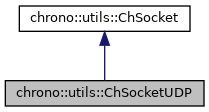
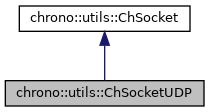
ChSocket for UDP (i.e.
datagram) communications. Three modes for sending|receiving are available:
- full-manual mode:
- user owns a buffer of type std::vector<char>
- single call to SendBuffer(const std::vector<char>&) | ReceiveBuffer(std::vector<char>&, int)
- user owns a message of type std::string
- single call to SendString(const std::string&) | ReceiveString(std::string&)
- user owns a buffer of type std::vector<char>
- templated mode:
- for sending:
- multiple calls to EnqueueData()
- single call to SendDataBuffer()
- for receiving:
- single call to ReceiveDataBuffer(int)
- multiple calls to ParseReceivedData()
- for sending:
- full-auto mode
- single call to SendData() | ReceiveData(), with all the variables involved
#include <ChSocket.h>
Public Member Functions | |
| ChSocketUDP () | |
| Default empty constructor. | |
| ChSocketUDP (int port_number) | |
| Create a UDP socket and assign it a unique ID. More... | |
| ~ChSocketUDP () | |
| Destroy UDP socket. | |
| bool | BindSocket () |
| Bind the socket to a local address and port number [SERVER SIDE]. More... | |
| bool | SetDestinationHost (const std::string &server_name_or_addr, HostType host_type) |
| Set destination host for subsequent communication [CLIENT SIDE]. More... | |
| void | SetDestinationPort (int port_number) |
| Set destination port for subsequent UDP communication [CLIENT SIDE]. | |
| int | SendString (const std::string &message_out) |
| Send a string message to the configured destination. More... | |
| int | ReceiveString (std::string &message_in, std::string &sender_host_name, int &sender_port_number) |
| Receive a string message from any sender. More... | |
| int | SendBuffer (const std::vector< char > &source_buffer) |
| Send a buffer of raw bytes to the configured destination. More... | |
| int | ReceiveBuffer (std::vector< char > &destination_buffer, int byte_size, std::string &sender_host_name, int &sender_port_number) |
| Receive a buffer of raw bytes from any sender. More... | |
| template<typename T > | |
| void | EnqueueData (const T &data_to_send) |
| Add data to the internal sending buffer. More... | |
| void | ClearInternalSendDataBuffer () |
| Clear the internal sending buffer populated by EnqueueData(). | |
| int | SendDataBuffer () |
| Send the data collected into the internal sending buffer, then clear it. More... | |
| int | ReceiveDataBuffer (int data_in_size, std::string &sender_host_name, int &sender_port_number) |
Receive one UDP datagram and store it, up to data_in_size bytes, into the internal receiving buffer. More... | |
| template<typename T > | |
| void | ParseReceivedData (T &data_read, int byte_offset=0) |
| Copy data from the internal receiving buffer, at the specified byte offset, into the given variable. More... | |
| template<typename DataInType , typename... DataInTypes> | |
| int | SendData (const DataInType &data_in_1, const DataInTypes &... data_ins) |
| Send the given variables as a single UDP datagram. More... | |
| template<typename DataInType , typename... DataInTypes> | |
| int | ReceiveData (DataInType &data_in_1, DataInTypes &... data_ins) |
| Receive the given variables from one UDP datagram. More... | |
 Public Member Functions inherited from chrono::utils::ChSocket | |
| ChSocket (int port_number) | |
| Create a socket and assign it a unique ID (aka. More... | |
| virtual | ~ChSocket () |
| Close and destroy socket. | |
| int | GetSocketId () |
| Get socket ID (aka. file descriptor). | |
| int | GetPortNumber () |
| Get socket port number. | |
| void | SetDebug (int debug_toggle) |
| Toggle socket options (either ON or OFF). | |
| void | SetReuseAddr (int reuse_toggle) |
| void | SetKeepAlive (int alive_toggle) |
| void | SetLingerOnOff (bool linger_on) |
| void | SetSocketBlocking (int blocking_toggle) |
| void | SetLingerSeconds (int seconds) |
| Set linger timeout on socket close (seconds). | |
| int | GetDebug () |
| Retrieve socket options. | |
| int | GetReuseAddr () |
| int | GetKeepAlive () |
| bool | GetLingerOnOff () |
| int | GetLingerSeconds () |
| int | GetSocketBlocking () |
| void | SetSendBufSize (int sendbuff_size) |
| Set the size of the socket send and receive buffer (bytes). | |
| void | SetReceiveBufSize (int recvbuff_size) |
| int | GetSendBufSize () |
| Get the size of the socket send and receive buffer (bytes). | |
| int | GetReceiveBufSize () |
Additional Inherited Members | |
| Protected Member Functions inherited from chrono::utils::ChSocket | |
| ChSocket () | |
| Only used when the socket is used for client communication. More... | |
| void | SetSocketId (int socketFd) |
| Protected Attributes inherited from chrono::utils::ChSocket | |
| int | socketId |
| Get the system errors. More... | |
| int | portNumber |
| socket port number | |
| int | blocking |
| blocking flag | |
| int | bindFlag |
| binding flag | |
| sockaddr_in * | clientAddr |
| address of the client that sent data | |
Constructor & Destructor Documentation
◆ ChSocketUDP()
| chrono::utils::ChSocketUDP::ChSocketUDP | ( | int | port_number | ) |
Create a UDP socket and assign it a unique ID.
Store the local port number for later use.
Member Function Documentation
◆ BindSocket()
| bool chrono::utils::ChSocketUDP::BindSocket | ( | ) |
Bind the socket to a local address and port number [SERVER SIDE].
Return true on success.
◆ EnqueueData()
|
inline |
Add data to the internal sending buffer.
When operation is completed, collected data can be sent at once using SendDataBuffer().
◆ ParseReceivedData()
|
inline |
Copy data from the internal receiving buffer, at the specified byte offset, into the given variable.
This method should be called (potentially multiple times) to access data received by ReceiveDataBuffer().
◆ ReceiveBuffer()
| int chrono::utils::ChSocketUDP::ReceiveBuffer | ( | std::vector< char > & | destination_buffer, |
| int | byte_size, | ||
| std::string & | sender_host_name, | ||
| int & | sender_port_number | ||
| ) |
Receive a buffer of raw bytes from any sender.
Sender host name and port number are additionally returned in provided arguments. The destination buffer is resized to the specified size in bytes before receiving. Return the number of bytes received.
◆ ReceiveData()
|
inline |
Receive the given variables from one UDP datagram.
The receiving order follows the order of the arguments. Return the number of bytes received.
◆ ReceiveDataBuffer()
| int chrono::utils::ChSocketUDP::ReceiveDataBuffer | ( | int | data_in_size, |
| std::string & | sender_host_name, | ||
| int & | sender_port_number | ||
| ) |
Receive one UDP datagram and store it, up to data_in_size bytes, into the internal receiving buffer.
Received data can be subsequently read using ParseReceivedData(). Sender host name and port number are additionally returned in provided arguments. This method clears the internal receiving buffer before operating. Return the number of bytes received.
◆ ReceiveString()
| int chrono::utils::ChSocketUDP::ReceiveString | ( | std::string & | message_in, |
| std::string & | sender_host_name, | ||
| int & | sender_port_number | ||
| ) |
Receive a string message from any sender.
Sender host name and port number are additionally returned in provided arguments. Return the number of bytes received.
◆ SendBuffer()
| int chrono::utils::ChSocketUDP::SendBuffer | ( | const std::vector< char > & | source_buffer | ) |
Send a buffer of raw bytes to the configured destination.
Return the number of bytes sent.
◆ SendData()
|
inline |
Send the given variables as a single UDP datagram.
The sending order respects the order of the arguments. Return the number of bytes sent.
◆ SendDataBuffer()
| int chrono::utils::ChSocketUDP::SendDataBuffer | ( | ) |
Send the data collected into the internal sending buffer, then clear it.
Return the number of bytes sent.
◆ SendString()
| int chrono::utils::ChSocketUDP::SendString | ( | const std::string & | message_out | ) |
Send a string message to the configured destination.
Return the number of bytes sent.
◆ SetDestinationHost()
| bool chrono::utils::ChSocketUDP::SetDestinationHost | ( | const std::string & | server_name_or_addr, |
| HostType | host_type | ||
| ) |
Set destination host for subsequent communication [CLIENT SIDE].
Target can be specified either by host name or IP address. Return true on success.
The documentation for this class was generated from the following files:
- /builds/uwsbel/chrono/src/chrono/utils/ChSocket.h
- /builds/uwsbel/chrono/src/chrono/utils/ChSocket.cpp