Description
Thermal load: radiation from surface.
Use this for applying a heat flux on the surface of finite elements, according to the Boltzmann law. If temperature is high enough, this can cause outgoing heat flux as radiating in outer space. Using this, one can simulate the black body radiation, etc. Negligible for low temperatures. Beware of the high nonlinearity because of the 4th power in the temperature.
#include <ChLoaderHeatRadiation.h>
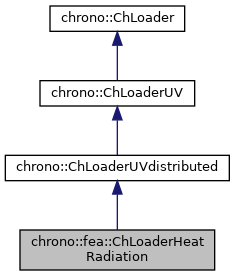
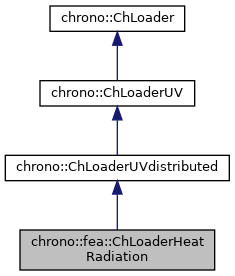
Public Member Functions | |
| ChLoaderHeatRadiation (std::shared_ptr< ChLoadableUV > mloadable, std::shared_ptr< ChFieldTemperature > temp_field) | |
| virtual void | ComputeF (double U, double V, ChVectorDynamic<> &F, ChVectorDynamic<> *state_x, ChVectorDynamic<> *state_w) override |
| Evaluate F = F(u,v) for this line load. More... | |
| void | SetSurfaceEmissivity (double emissivity) |
| Set the emissivity e in W = e * sigma * T^4 Boltzmann law. More... | |
| double | GetSurfaceEmissivity () |
| Get the emissivity e in W = e * sigma * T^4 Boltzmann law. | |
| void | SetEnvironmentTemperature (double T_env) |
| Set the imposed environment temperature at the external of the surface (the smaller the delta with the FE temperature, the less radiation). More... | |
| double | GetEnvironmentTemperature () |
| Get the imposed environment temperature at the external of the surface (the smaller the delta with the FE temperature, the less radiation). More... | |
| void | SetIntegrationPoints (int val) |
| virtual int | GetIntegrationPointsU () override |
| virtual int | GetIntegrationPointsV () override |
 Public Member Functions inherited from chrono::ChLoaderUVdistributed Public Member Functions inherited from chrono::ChLoaderUVdistributed | |
| ChLoaderUVdistributed (std::shared_ptr< ChLoadableUV > mloadable) | |
| virtual void | ComputeQ (ChVectorDynamic<> *state_x, ChVectorDynamic<> *state_w) override |
| Compute the generalized load Q = integral (N'*F*detJ dudvdz), using the ComputeF method. More... | |
| Public Member Functions inherited from chrono::ChLoaderUV | |
| ChLoaderUV (std::shared_ptr< ChLoadableUV > mloadable) | |
| void | SetLoadable (std::shared_ptr< ChLoadableUV > mloadable) |
| virtual std::shared_ptr< ChLoadable > | GetLoadable () override |
| std::shared_ptr< ChLoadableUV > | GetLoadableUV () |
| Public Member Functions inherited from chrono::ChLoader | |
| virtual bool | IsStiff () |
Additional Inherited Members | |
| Public Attributes inherited from chrono::ChLoaderUV | |
| std::shared_ptr< ChLoadableUV > | loadable |
| Public Attributes inherited from chrono::ChLoader | |
| ChVectorDynamic | Q |
Member Function Documentation
◆ ComputeF()
|
overridevirtual |
Evaluate F = F(u,v) for this line load.
The vector F is set to zero on entry. The function provided by derived classes is called by ComputeQ to perform integration over the domain.
- Parameters
-
U parametric coordinate in surface V parametric coordinate in surface F result vector, size = field dim of loadable state_x if != 0, update state (pos. part) to this, then evaluate F state_w if != 0, update state (speed part) to this, then evaluate F
Implements chrono::ChLoaderUV.
◆ GetEnvironmentTemperature()
|
inline |
Get the imposed environment temperature at the external of the surface (the smaller the delta with the FE temperature, the less radiation).
◆ SetEnvironmentTemperature()
|
inline |
Set the imposed environment temperature at the external of the surface (the smaller the delta with the FE temperature, the less radiation).
◆ SetSurfaceEmissivity()
|
inline |
Set the emissivity e in W = e * sigma * T^4 Boltzmann law.
Typically a value in 0...1 range, with 1 as black body
The documentation for this class was generated from the following files:
- /builds/uwsbel/chrono/src/chrono/fea/multiphysics/ChLoaderHeatRadiation.h
- /builds/uwsbel/chrono/src/chrono/fea/multiphysics/ChLoaderHeatRadiation.cpp