Description
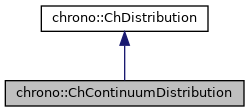
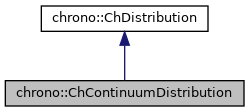
Class that can be used to generate sample numbers according to a probability distribution.
Probability distribution is defined with x,y points, at least a dozen of pairs to be more precise in the reconstruction of probability. It uses the "Smirnov transform" (inverse probability integral transform)
#include <ChRandom.h>
Public Member Functions | |
| ChContinuumDistribution (ChVectorDynamic<> &x, ChVectorDynamic<> &y) | |
| Create an object that can be used to generate sample numbers according to a generic probability distribution. More... | |
| virtual double | GetRandom () override |
| Compute a random value whose probability is the probability curve that has been entered with x,y points during the creation of this object. | |
| const ChVectorDynamic & | GetProbabilityXPoints () const |
| const ChVectorDynamic & | GetProbabilityYPoints () const |
| const ChVectorDynamic & | GetProbabilityCDFCumulativeX () const |
| const ChVectorDynamic & | GetProbabilityCDFCumulativeY () const |
Constructor & Destructor Documentation
◆ ChContinuumDistribution()
| chrono::ChContinuumDistribution::ChContinuumDistribution | ( | ChVectorDynamic<> & | x, |
| ChVectorDynamic<> & | y | ||
| ) |
Create an object that can be used to generate sample numbers according to a generic probability distribution.
The probability distribution is a curve represented by simplified x,y pairs of points. The integral of the probability curve must be unit, i.e normalized (but if not, a normalization will be enforced) Note: too few points means approximate results, but too many points might give a small performance overhead when calling GetRandom().
The documentation for this class was generated from the following files:
- /builds/uwsbel/chrono/src/chrono/core/ChRandom.h
- /builds/uwsbel/chrono/src/chrono/core/ChRandom.cpp